
Owner Questions · Metal Roof Coating
Bowling Green Metal Roof Coating Questions
Metal roof coating questions from Bowling Green building owners, answered in plain terms: rust, fasteners, coating choice, weather, cost, permits, and utilities.
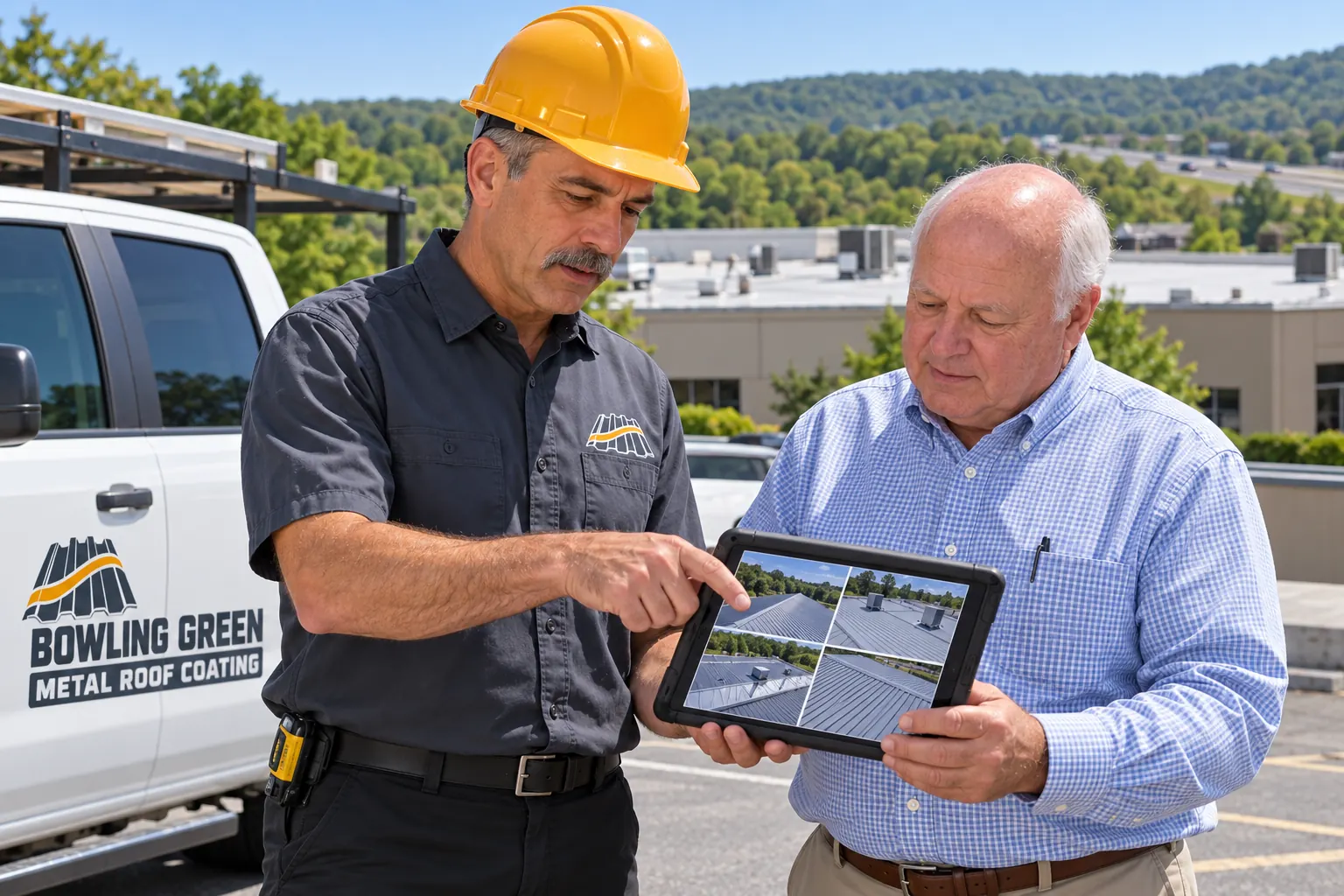 1Ask Your Questions
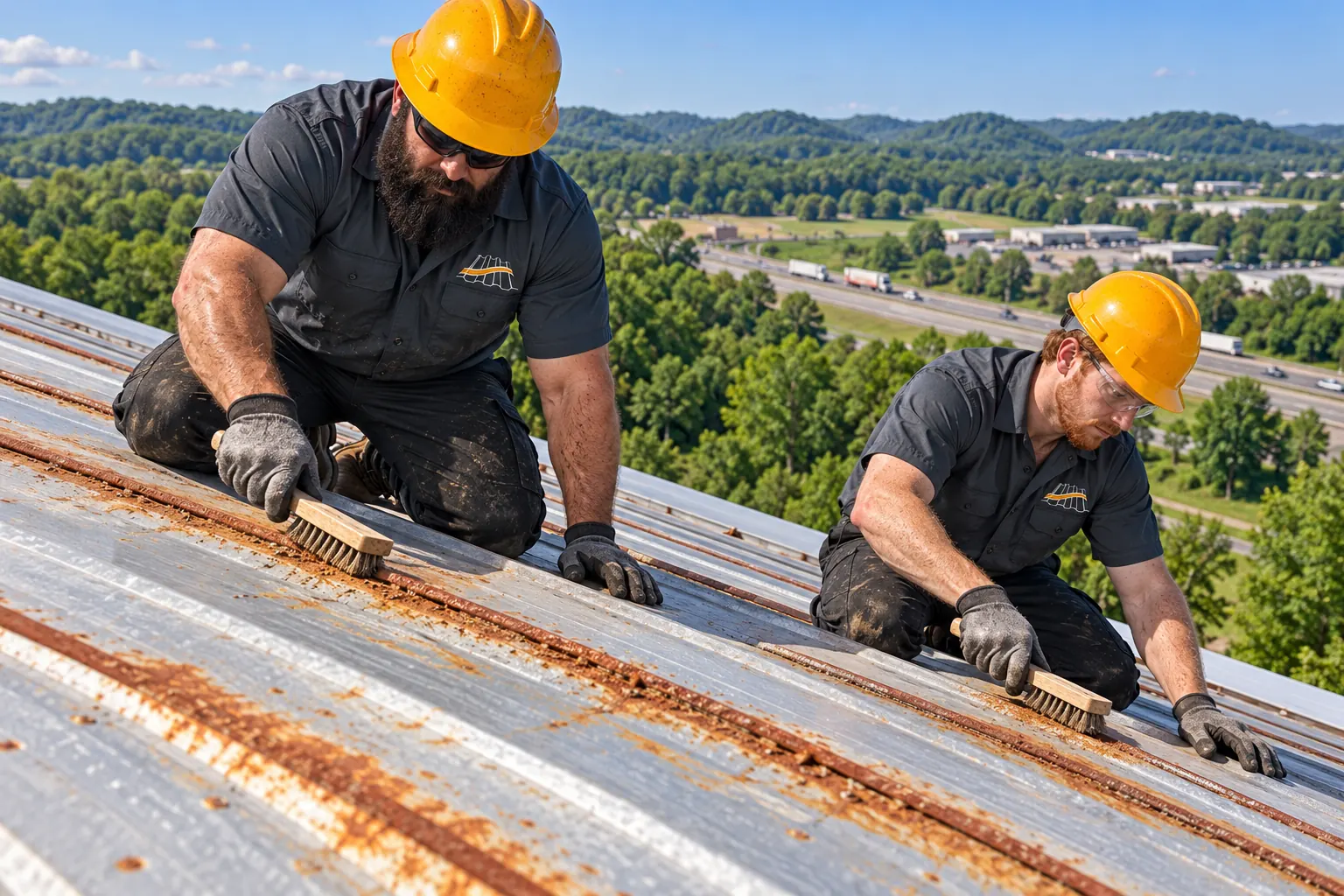 2See The Prep
Start Here
Metal Roof Coating Questions From Bowling Green Owners
Metal roof coating is a liquid membrane applied by roller or spray to cleaned steel panels, closing up fastener holes, laps, and seams while it holds back rust. Bowling Green Metal Roof Coating coats commercial metal roofs and applies silicone, acrylic, spray foam, and shingle coatings in Bowling Green, Warren County, Kentucky, and nearby towns.
Metal Roof Coating Basics
What does a metal roof coating actually do on a commercial building?
A metal roof coating forms a continuous rubbery film over the panels that seals screw heads, panel laps, and seams while shielding bare steel from water and sunlight. Most leaks on older metal buildings start at small openings: a washer that has dried and cracked, an end lap where sealant tape shrank, or a ridge cap with loose stitch screws.
The coating bridges those gaps once they are cleaned and reinforced. A light-colored top coat also reflects sunlight. U.S. Department of Energy guidance rates that effect by solar reflectance and thermal emittance, each scored from 0 to 1, with higher numbers meaning a cooler roof.
Which metal buildings around Bowling Green are good candidates for coating?
Exposed-fastener metal buildings with surface rust and leaking laps, but firm steel underneath, are the strongest candidates for coating. Common examples in south central Kentucky:
- Warehouses and light manufacturing plants with R-panel roofs
- Farm shops, equipment sheds, and livestock barns
- Church fellowship halls and gyms built as pre-engineered steel structures
- Self-storage buildings with long low-pitch panel runs
- Auto service shops with skylight panels and exhaust vents
Buildings with many rusted-through panels, sagging purlins, or wet insulation trapped under the steel need those problems handled first. A coating seals and protects the surface and adds no structural strength.
Can a coating go on a standing seam roof as well as an exposed-fastener roof?
Yes, both standing seam and exposed-fastener metal roofs take coatings, though the prep and the leak points differ. Exposed-fastener roofs, such as R-panel and PBR panel, leak mostly at screws, washers, and side laps, so prep centers on fasteners.
Standing seam roofs hide their clips under the seams. Leaks there show up at end laps, ridge closures, curbs, and the trim around skylights and gutters. Standing seam panels also move more with temperature, because floating clips let them slide. Seam treatment on those roofs uses flexible reinforcing fabric and keeps stiff sealant out of the slide path.
Rust, Fasteners and Seams
Can you coat over a rusted metal roof?
A rusted metal roof can be coated once loose rust is removed and the remaining steel is treated with a rust-inhibiting primer. Light red rust and rust bloom around screw heads respond well to wire brushing and pressure washing. Scaly rust that flakes off in sheets gets scraped down to firm steel.
Panels with holes you can see daylight through need new metal. Crews cut in patch panels or replace full sheets, then fasten and seal the laps before primer goes on. Coating over loose scale traps it under the film, and the coating peels when the scale lets go.
What is white rust on a galvanized metal roof?
White rust is a powdery white or gray deposit that forms when the zinc layer on galvanized steel corrodes. It shows up where water sits on panels, under leaf piles, and along gutters and valleys. It signals that the zinc protection is wearing, often before the base steel turns red.
Coatings bond poorly to white rust and to the oily film on newer galvanized or Galvalume panels. Prep for these roofs includes a cleaner made for that surface, a full rinse, and a primer the coating maker lists for galvanized steel. Adhesion test patches on a few panels confirm the bond before the whole roof is coated.
What happens to the screws and washers when a metal roof is coated?
Every fastener gets checked, and loose, stripped, or rusted screws are tightened or swapped for larger-diameter replacements before coating. The rubber washers under screw heads dry out and crack after years of sun, which lets water follow the screw shank into the building.
Once each screw is snug, crews cover the head with brush-grade sealant or a fastener-sealing mastic. Some systems also call for a fabric patch over each fastener. Missing screws along purlin lines leave panels free to flutter in wind, so those get replaced too.
How are panel laps, end laps, and seams sealed before coating?
Side laps, end laps, and seams get cleaned, then sealed with reinforcing fabric bedded in a base coat or with a seam sealant made for the coating system. End laps leak often, because water running down the slope gets pulled under the upper panel by capillary action.
Seam treatment usually covers:
- Horizontal end laps across the full width of the roof
- Vertical side laps at panel edges
- Ridge cap and hip cap joints
- Curb, pipe, and skylight panel flashings
- Gutter seams and gutter-to-panel transitions
Choosing a Coating
Silicone, acrylic, or urethane: which coating is best over metal?
The best coating for a metal roof matches the roof's pitch, drainage, and foot traffic, and each coating family has a clear strength.
| Coating | Where it fits on metal | Watch-outs |
|---|---|---|
| Silicone | Low-pitch panels with slow drainage near gutters and curbs | Holds dirt; later recoats need silicone again |
| Acrylic | Sloped panels that shed water fast; bright white finish | Softens where water stands; needs drying weather |
| Urethane | Base coats, seams, and walk paths around rooftop units | Stronger odor while curing; often topped with another coat |
Many metal systems combine a rust-inhibiting primer, a seam sealant, and one of these as the top coat. The coating maker's product data and approved primer list settle which pairings work together.
When does silicone roof coating make sense on a metal building?
Silicone makes sense on metal roofs where water lingers, such as low-pitch panels near gutters, around curbs, or behind skylight panels that dam runoff. It resists breakdown under standing water and sunlight better than water-based acrylic.
It has trade-offs. Silicone surfaces hold dirt, which dulls the white finish over time. Only silicone bonds well to old silicone, so the first choice locks in future recoats. Silicone also gets slick when wet or frosty, so walk paths to HVAC units and roof hatches need granules or a textured finish.
When is acrylic roof coating the better pick over metal?
Acrylic is a strong pick for metal roofs with enough pitch to shed water quickly, where its bright white finish and water-based cleanup help. Many pre-engineered buildings around Warren County have panels that drain well, which fits acrylic.
Acrylic needs dry, mild weather to cure, because rain or heavy dew on a fresh coat can wash it off before it sets. That shortens the application window in late fall. Ponding along a gutter edge or behind a rooftop curb is its weak spot, so those low areas often get a silicone strip or a different product.
Is spray foam over a metal roof better than coating alone?
Spray foam adds insulation and fills panel corrugations, while coating alone seals and protects the steel without adding R-value.
| Factor | Coating only | Spray foam plus coating |
|---|---|---|
| Insulation | Little to none | Closed-cell foam at about R-6.1 per inch (DOE Building America) |
| Fastener and lap leaks | Sealed with mastic and fabric | Buried under foam |
| Added roof height | A few mils | Inches, so curbs and trim need checking |
| Condensation under bare steel | Unchanged | Reduced, since foam keeps the steel warmer |
| Main cost drivers | Cleaning, rust work, seams | Same, plus foam passes and trim changes |
Foam pays off on uninsulated buildings where panels sweat in winter. Coating alone fits insulated buildings that mainly leak at fasteners and laps.
Can a commercial shingle roof be coated?
Some asphalt shingle roofs on commercial buildings can be coated when the coating maker approves its product for shingles and the shingles still lie flat and hold their granules. In Warren County, that list usually covers shingled strip centers, office buildings, and churches.
Shingles that curl, crack, or shed granules into gutters are too far gone. Coating also changes how the roof sheds water and breathes, so check the shingle manufacturer's warranty terms and the coating maker's slope and ventilation requirements first. Lifted tabs, nail pops, and soft decking get repaired before any coating goes on.
Climate and Weather in South Central Kentucky
How does Bowling Green's rain and freeze-thaw weather affect metal roofs?
Bowling Green's steady rain and frequent freeze-thaw swings attack the same weak points on a metal roof: laps, fasteners, and gutters. NWS Louisville's 1991 to 2020 normals put the city at about 50 inches of precipitation and about 8.5 inches of snow a year, with a January mean near 37 degrees Fahrenheit.
Water drawn into an end lap freezes overnight and pries the joint open a little more each winter. Leaf-filled gutters back water under eave trim. Sealing laps and clearing gutters before late fall keeps that cycle from widening small leaks.
What did the December 2021 tornadoes teach about metal roofs?
The December 11, 2021 tornadoes showed that metal roofs fail first at edges, trim, and loose fasteners, where wind gets a grip. NWS Louisville rated the main Bowling Green tornado EF-3, with peak winds near 165 mph, and logged a second EF-2 tornado near the regional airport.
A coating seals a roof and does not tie panels to purlins. Wind resistance comes from fasteners, clips, and trim. After a storm, check for:
- Eave and rake trim pulled loose
- Ridge caps lifted or missing stitch screws
- Panels creased or bent at corners
- Fasteners backed out along purlin lines
Those get re-secured before any coating.
Can a coated metal roof handle hail?
A coated metal roof handles small hail well, and large stones dent the steel with or without a coating. The coating adds a flexible film that resists cracking at a dent, and a thicker base coat or urethane layer adds some impact resistance.
After a hailstorm, look for:
- Round dents on ridge caps and panel ribs
- Cracked or holed skylight panels
- Chipped coating exposing bare or primed steel
- Crushed gutters and dented vent caps
Dents with the coating still intact are mostly cosmetic. Cracked skylight panels and open chips need sealing before water reaches the steel.
Does a white roof coating help a metal building in Kentucky's climate?
White coatings cut summer heat gain through a metal roof, and DOE's cool roof guide says that in mixed climates the winter heating penalty is usually smaller than the summer savings. Faded steel gets hot in July sun, and that heat moves straight into buildings with thin or no insulation.
The same guide notes the largest savings come in hot climates and that a cool roof can raise winter heating use. Results here turn on insulation under the panels, rooftop HVAC, and building hours. The Cool Roof Rating Council directory lists rated reflectance and emittance values for coating products.
Question About Your Own Roof?
Call us and describe the building. We answer it for your roof in particular.
Prep, Application and Downtime
How does prep differ for standing seam and exposed-fastener roofs?
Exposed-fastener roofs need screw-by-screw work, while standing seam roofs need flexible seam and trim details that let panels move.
| Prep item | Exposed-fastener (R-panel, PBR) | Standing seam |
|---|---|---|
| Fasteners | Tighten, replace, and seal every screw head | Hidden clips; check exposed trim screws |
| Laps | Seal side laps and end laps | Seal end laps and panel terminations |
| Thermal movement | Lower; panels fixed to purlins | Higher; seams need flexible reinforcing |
| Common leak points | Washers, laps, skylight panels | Ridge closures, curbs, gutters |
| Rust treatment | Around screw holes and laps | Panel ends and cut edges |
Both roof types get cleaned, rust treated, and primed with the coating maker's listed primer before seams and top coats go on.
What are the steps to coat a commercial metal roof?
Coating a metal roof follows a set order, and each step depends on the one before it.
- Inspect Your Roof for rust-through, loose fasteners, open laps, and wet insulation.
- Clean panels with pressure washing and a cleaner matched to the metal.
- Repair holes, replace rusted panels, and tighten or swap fasteners.
- Prime rusted areas and galvanized surfaces with the listed primer.
- Seal fasteners, laps, seams, curbs, and skylight panel edges.
- Apply base and top coats to the thickness the coating maker specifies.
Wet-film gauges confirm thickness as the work goes. Weather and the amount of repair set the pace more than roof size.
Can a business keep operating while its metal roof is coated?
Most businesses keep running during a metal roof coating, since the work stays on top of the panels. Pressure washing and spraying bring the main disruptions, so crews plan around them.
Common arrangements include:
- Covering or shutting down rooftop air intakes near the work
- Roping off parking along the walls to catch overspray drift
- Scheduling loading dock and skylight work during slow shifts
- Naming one building contact for access and unit shutdowns
Rinse water leaves through gutters and downspouts, so drains and landscaping near them get checked first.
Cost, Value and Taxes
What drives the cost of coating a metal roof?
Roof size, the amount of rust and fastener work, and the coating system chosen drive most of the cost of coating a metal roof. Other drivers:
- Number of panels needing replacement or patching
- Fastener count, since every screw head gets sealed
- Linear feet of laps, seams, and ridge caps to reinforce
- Skylight panels, curbs, and pipes to flash
- Access, such as lift rental or tall eaves
- Primer needs for galvanized or heavily rusted steel
A roof with light chalking and tight fasteners takes far less labor than one with red rust at every lap.
Should a metal roof be coated, restored, re-paneled, or replaced?
Panel and framing condition decides between coating, restoration, re-paneling, and replacement. Restoration means coating plus the repair work that comes first.
| Roof condition | Usual path |
|---|---|
| Chalking, faded paint, a few leaking screws | Coat after cleaning and fastener sealing |
| Rust bloom at laps, many failed washers, scattered pinholes | Restore with rust treatment, patches, and full seam work, then coat |
| Rust-through on whole panels or crushed sheets | Re-panel those sections, then coat |
| Sagging purlins, failed framing, or widespread rust-through | Replace the roof system |
Catching rust at the bloom stage keeps a roof in the top two rows. Wet insulation under the panels pushes the choice further down.
Does Section 179 cover a commercial metal roof coating?
Section 179 can cover roof work on existing nonresidential buildings, since IRS Publication 946 lists roofs among qualifying improvements to nonresidential real property. For 2026, the maximum deduction is $2,560,000, reduced once qualifying property placed in service tops $4,090,000. Residential rental property is excluded.
Whether a given coating job counts as a roof improvement or a repair is a tax question. Keep invoices that separate panel replacement, fastener work, and coating from rooftop equipment, and review the details with a CPA before filing.
Permits, Codes and Utilities
Do you need a permit to coat a commercial metal roof in Bowling Green?
The City of Bowling Green Building Division, within Neighborhood and Community Services, decides permit needs for buildings inside city limits. Its plan review page says plans must be approved through the division before work starts, and its fee schedule references the 2018 Kentucky Building Code.
Roof coating has no separate line on the city's permit list. Call the division with the scope written out: whether panels are replaced, whether foam adds height, and whether rooftop units, skylight panels, or gutters change. Work that alters structure or equipment draws more review than a coating over existing steel.
Who handles commercial building permits in each town?
Permit contacts change by town and county, and Kentucky's Department of Housing, Buildings and Construction posts county sheets naming local and state inspectors.
| Town | County | Where to start |
|---|---|---|
| Bowling Green | Warren | City Building Division |
| Franklin | Simpson | City of Franklin zoning office; state inspectors on the Simpson sheet |
| Russellville | Logan | City Building Official |
| Auburn | Logan | Auburn city hall and Logan County offices |
| Scottsville | Allen | Local inspector covering Allen County and the city |
| Morgantown | Butler | Butler County local building inspector |
Bring photos of panels, trim, gutters, and rooftop units to the first call.
Which electric utilities serve buildings around Bowling Green?
Municipal power boards serve the larger city limits around Bowling Green, and rural cooperatives serve most of the countryside.
- BGMU serves Bowling Green city limits.
- Franklin Electric Plant Board serves Franklin city limits.
- Russellville Electric Plant Board serves Russellville city limits.
- Warren RECC covers parts of Warren, Simpson, Logan, Butler, and other counties.
- Tri-County Electric lists Allen County and Scottsville.
TVA EnergyRight's current business incentive list covers HVAC, lighting, and custom projects, and roof coatings are absent from it. Ask the utility in writing before counting on any incentive, especially when new rooftop units ride along with the coating.
Questions by Town
Which Bowling Green buildings see the most metal roof coating work?
Industrial and distribution buildings with wide steel roofs are prime coating candidates in Bowling Green. General Motors has built the Corvette at Bowling Green Assembly since 1981, and the Kentucky Transpark in northern Warren County adds industrial sites with direct access to I-65 at Exit 30.
Plant and warehouse roofs like these carry exhaust fans, skylight panels, and pipe supports, each a joint to seal. Ridge caps and end laps hundreds of feet long expand and contract every day. Coating seals those joints from above while work continues on the plant floor.
Does a metal building in rural Warren County deal with different offices than one in the city?
Yes, a metal building outside Bowling Green city limits works with county offices and often Warren RECC, while one inside works with the city Building Division and BGMU. The city's permit page applies only inside its limits and points to the Warren County Planning Commission for zoning.
For rural shops and barns, confirm the county permit contact before panel replacement or added foam. Check which utility owns the service mast and meter on the wall, since disconnecting unit heaters or exhaust fans for spraying runs through that provider.
Who answers building questions for a Franklin metal roof project?
The City of Franklin zoning office is the city contact on Kentucky's Simpson County inspection sheet, which also names state inspectors for building, electrical, HVAC, and plumbing. That split matters when coating work touches more than the panels.
Raising rooftop unit curbs for spray foam, moving conduit off the roof, or swapping exhaust fans brings electrical or HVAC review alongside the roof. A coating over existing steel, with panels and trim left in place, is a smaller scope. Describe both pieces clearly on the call, and have photos of curbs and skylight panels ready.
Which utility serves a Franklin building, and why does it matter for roof work?
Franklin Electric Plant Board serves more than 4,800 customers within Franklin city limits, according to TVA's local power company directory, while Warren RECC serves parts of the surrounding county. The bill shows which one feeds a given building.
That matters on coating jobs because rooftop exhaust fans, unit heaters, and HVAC units near the spray zone get shut down for a day or more. Service masts and weatherheads that pass through metal panels also need fresh flashing and sealant around the boot before the top coat goes on.
What does Russellville require for commercial roof and HVAC work?
Russellville's City Building Official takes building permit applications and issues certificates of occupancy, and the city has adopted the International Building Code for commercial projects. When metal roof work moves or replaces rooftop HVAC, the city asks for HVAC plans, drawings, and load calculations to be approved by the Building Official before the state HVAC permit is pulled.
Plan curb heights and duct transitions early if foam or new curbs raise rooftop units. A coating-only job over existing panels keeps that HVAC step off the schedule.
Who supplies power to Russellville commercial buildings?
Inside Russellville city limits, power comes from Russellville Electric Plant Board, which has close to 4,000 commercial and household accounts in TVA's directory. Buildings outside town in Logan County can be on Warren RECC lines, since the cooperative serves part of the county.
For a metal roof coating, the provider matters when rooftop units and exhaust fans shut down for spraying. Conduit straps screwed through the panels need their fastener holes sealed, and junction boxes stay clear of coating so they can still be opened.
Who inspects commercial building work in Scottsville?
One local building inspector covers both Allen County and the City of Scottsville, according to Kentucky's Allen County contact sheet, which also lists a state building inspector. A building near the town line deals with the same local office either way.
For a metal roof coating, have photos of rusted panels, gutters, and any rooftop units being lifted or moved. Replacing panels or changing roof drainage draws the most questions, and a coating over existing, firm steel is a lighter scope.
Which electric cooperative serves Scottsville, and what should rural owners watch for?
Tri-County Electric lists Allen County and Scottsville in its service area and keeps a district office in Scottsville, with territory spanning Kentucky and Tennessee. Check the bill before scheduling shutdowns of shop heaters or exhaust fans tied to the building.
For farm and shop buildings with exposed-fastener roofs, leaks start at screws and end laps, and long eave runs send heavy rain over gutters that are too small. Sealing fasteners and laps, then coating, keeps water off the purlins. Larger gutters or added downspouts handle the overflow.
Who handles building inspection for a Morgantown roof project?
Butler County's local building inspector is the starting point for Morgantown, since Kentucky's Butler County contact sheet lists a county inspector and a state building inspector with no separate city entry. Confirm with Morgantown city hall for buildings inside city limits.
Have the scope written plainly: which panels get replaced, whether skylight panels change, whether gutters and downspouts move, and whether foam raises the roof height at curbs. Those details shape what the inspector wants to see.
What should Morgantown owners check on older metal buildings before coating?
Older metal buildings around Morgantown need a fastener, lap, and gutter check before coating, plus a confirmed power provider for rooftop shutdowns. Warren RECC serves all or part of Butler County, so many area buildings sit on cooperative lines.
On the roof, look for:
- Rust bloom along end laps and at panel ends near the eave
- Screws backed out near the ridge
- Gutters pulling away from eave trim
- Skylight panels yellowed or cracked
Each of those gets fixed before primer and coating go down.
Where do Auburn property owners start with building permits?
Auburn property owners start with Auburn city hall and Logan County offices, because Kentucky's Logan County contact sheet lists the Logan County Health Department rather than a city building contact. Confirm the permit path before panel replacement or added roof height.
Small-town commercial buildings often mix roof types, such as a metal-roofed shop behind a storefront with a flat parapet roof and through-wall scuppers. Each section gets its own scope. Metal panels get fastener and lap work, and flat sections get checked for moisture and existing layers.
Which utility serves buildings around Auburn, and how does condensation factor in?
Warren RECC serves all or part of Logan County, so rural buildings around Auburn are likely on its lines; confirm the provider on the bill before rooftop shutdowns. Agricultural and light industrial buildings with metal roofs over open framing often drip condensation from bare steel in cold weather.
An exterior coating seals laps and fasteners and leaves that condensation in place. Spray foam over the panels insulates the steel and cuts the dripping. Ridge caps, end laps, and skylight panels get extra attention because they leak first.
Getting Started
What should I have ready before a metal roof inspection?
Roof age, leak history, and past repair records make a metal roof inspection faster and more useful. Helpful items:
- Photos of ceiling stains or drips, with dates
- Building drawings showing panel type and roof size
- Records of earlier coatings, sealants, or panel swaps
- Notes on rooftop units that run around the clock
Mark leak spots on a floor plan. Matching those marks to laps, fasteners, skylight panels, and gutters above shortens the search for each source.
What happens during a metal roof coating inspection?
A metal roof coating inspection walks the full roof to check panels, fasteners, laps, trim, and drainage, then sorts the roof into coating, restoration, re-paneling, or replacement. The inspector tests loose screws, probes rust spots for soft steel, checks skylight panels and curbs, and looks at gutters and downspouts.
Adhesion test patches show whether the coating bonds to the existing paint or galvanized surface. Moisture readings flag wet insulation under the panels. Photos tie each finding to a spot on the roof, and Bowling Green Metal Roof Coating explains which path fits.
Sources
- U.S. Department of Energy, Guide to Cool Roofs
- Cool Roof Rating Council, Rated Roof Products Directory
- ENERGY STAR, Cool Roofs and Emissivity
- U.S. DOE Building America, Spray Foam Guide
- NWS Louisville, Bowling Green Climate
- NWS Louisville, Bowling Green 1991 to 2020 Normals
- NWS Louisville, December 11, 2021 Tornadoes
- IRS Publication 946
- City of Bowling Green, Building Division
- City of Bowling Green, Plan Reviews
- City of Bowling Green, Permit Applications
- Kentucky Department of Housing, Buildings and Construction, Simpson County contacts
- Kentucky Department of Housing, Buildings and Construction, Logan County contacts
- Kentucky Department of Housing, Buildings and Construction, Allen County contacts
- Kentucky Department of Housing, Buildings and Construction, Butler County contacts
- City of Russellville, Building Permit
- TVA, Bowling Green Municipal Utilities
- TVA, Franklin Electric Plant Board
- TVA, Russellville Electric Plant Board
- TVA, Warren Rural Electric Cooperative Corporation
- Tri-County Electric, About
- TVA EnergyRight, Business Incentives
- General Motors, Bowling Green Assembly
- Bowling Green Area Chamber of Commerce, Kentucky Transpark Interchange
Turn Answers Into A Plan
Tell us about the roof and we follow up to walk it with you in Bowling Green or nearby.